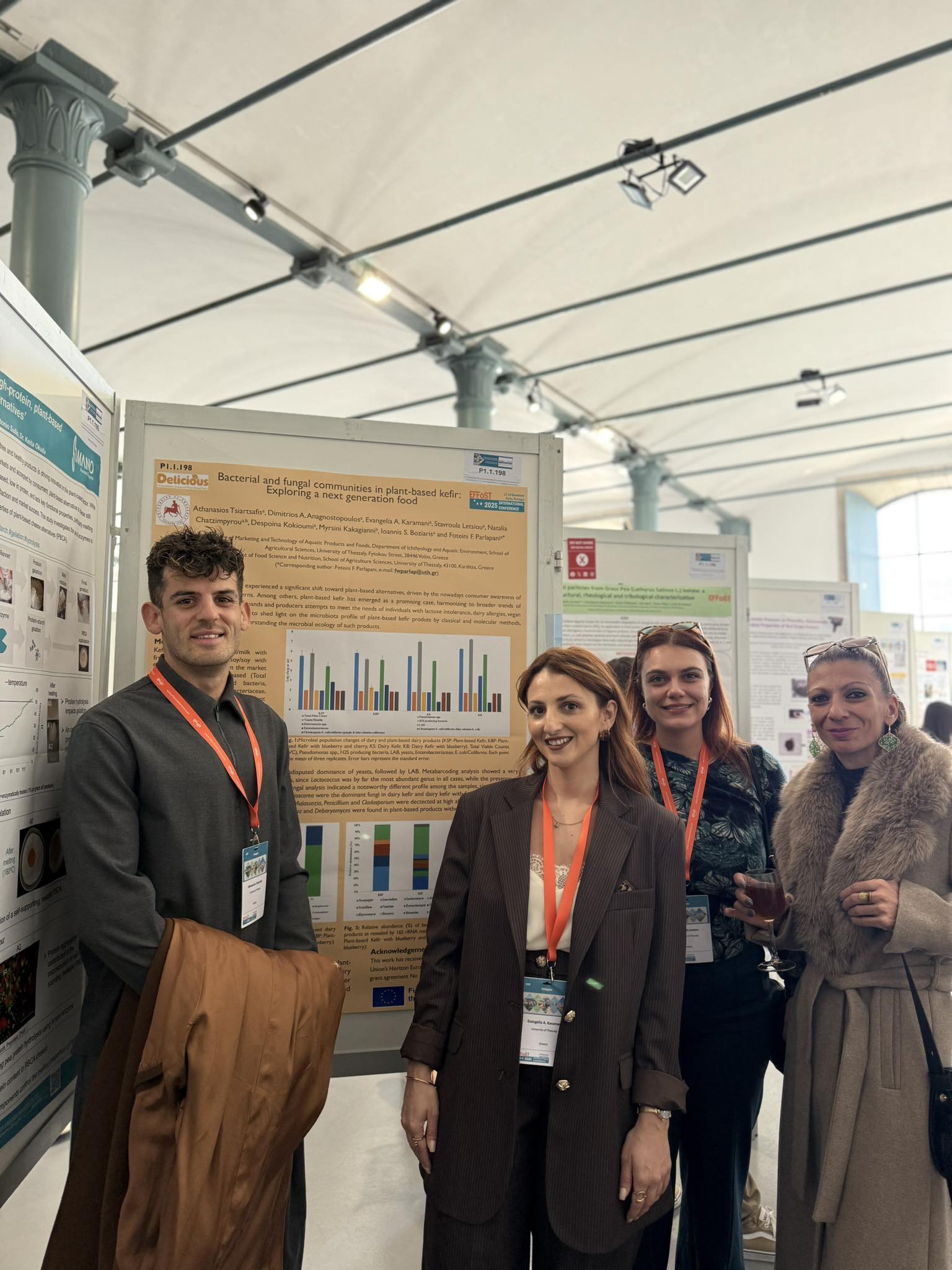
The results of the UTH research team (produced under the supervision of PI: Associate Professor F.F. Parlapani), within the framework of the Delicious project, regarding the bacterial and fungal status of plant-based cheese, kefir, and Brie compared to animal origin, using classical microbiological analysis (for the enumeration of microbial populations) and Next Generation Sequencing (16S rRNA and ITS sequencing for the exploration of bacterial and fungal communities, respectively), were successfully presented at the 39th European Federation of Food Science and Technology (EFFoST) International Conference, Fostering the Transition to Sustainable Food Systems: Embracing Novelty and Overcoming Challenges, hosted by Universidade Católica Portuguesa – Faculty of Biotechnology and held in Porto, Portugal, on 17–19 November 2025.
The posters were presented during Poster Session 2 on Tuesday, 18 November 2025, in the Exhibition Hall of Alfândega Congress Center (Porto, Portugal). During the session, several participants from universities, research institutes, and the food industry expressed interest in the findings on the products studied.
The three posters presented by the UTH research team under the supervision of PI Associate Prof. F.F. Parlapani were:
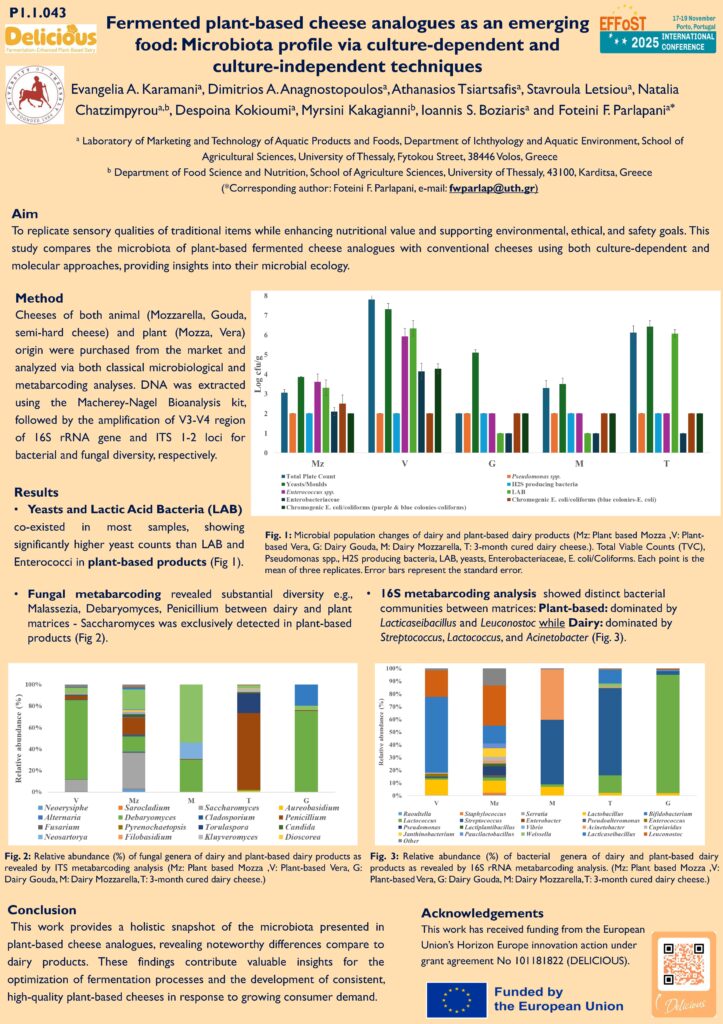
Fermented plant-based cheese analogues as an emerging food: Microbiota profile via culture-dependent and culture-independent techniques
PhD candidate Evelina Karamani presented this study, which compared the microbiota of plant-based and dairy cheeses using classical microbiological analysis and high-throughput sequencing (16S rRNA and ITS).
Commercial animal-origin (Mozzarella, Gouda, semi-hard cheese) and plant-based (Mozza, Vera) products were analyzed for key microbial groups. Yeasts and LAB dominated most samples, although plant-based cheeses showed notably higher yeast levels.
Metabarcoding revealed shared fungal taxa but distinct bacterial profiles, with Lacticaseibacillus and Leuconostoc prevailing in plant-based products.
These findings support improved fermentation strategies for producing high-quality plant-based cheeses.
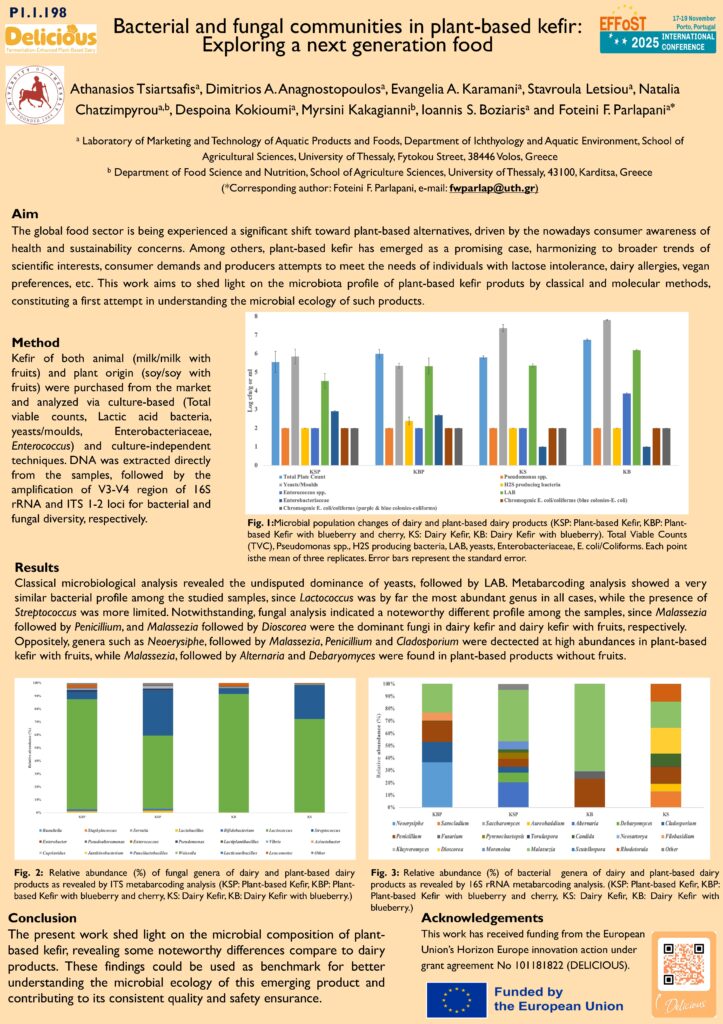
Bacterial and fungal communities in plant-based kefir: Exploring a next- generation food.
PhD candidate Athanasios Tsiartsafis presented this study, which characterized the microbiota of plant-based kefir using classical microbiology (culture dependent) and high-throughput sequencing (16S rRNA and ITS), comparing it with dairy kefir.
Commercial dairy (plain and fruit) and plant-based (soy and soy with fruit) kefir samples were analyzed. Yeasts and LAB dominated all samples, while Enterobacteriaceae were less prevalent in plant-based products.
Metabarcoding revealed similar bacterial profiles, mainly Lactococcus, but distinct fungal communities between dairy and plant-based kefir.
These findings provide initial insights into the microbial ecology of this emerging product.
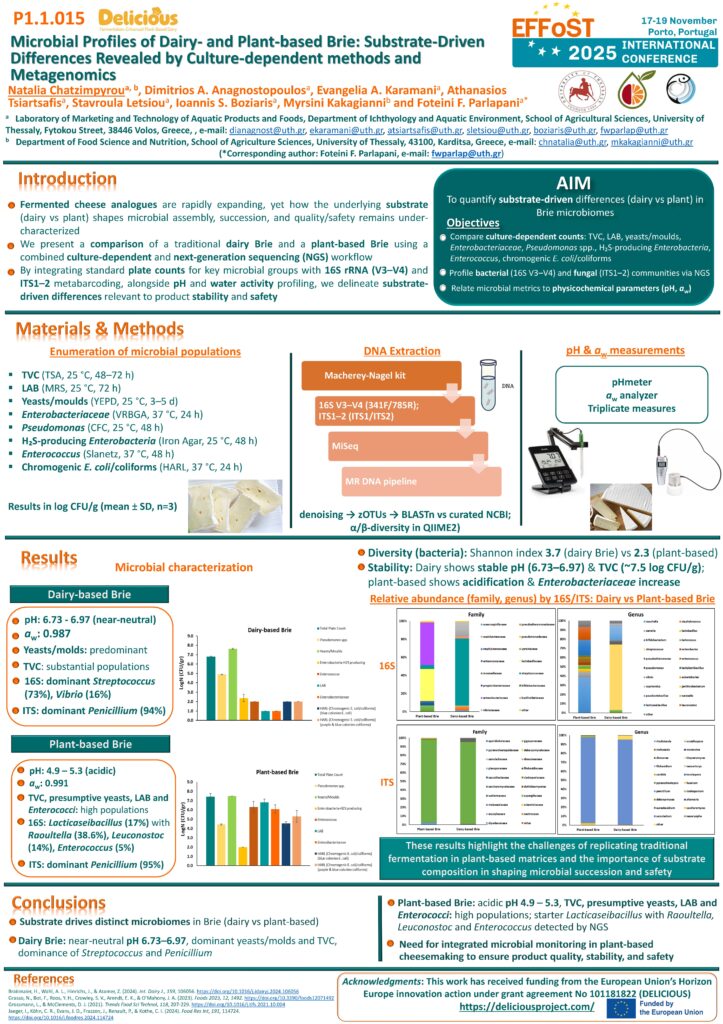
Microbial profiles of dairy- and plant-based Brie: Substrate-driven differences revealed by culture-dependent methods and metagenomics
PhD candidate Natalia Chatzimpyrou presented this study comparing the microbial diversity of dairy and plant-based Brie. Using culture-dependent methods and high-throughput sequencing (16S rRNA, ITS), along with pH and water activity measurements, dairy Brie showed a stable ecosystem dominated by Streptococcus and Penicillium.
Plant-based Brie was more acidic, dominated by Lacticaseibacillus, and included potential contaminants (Raoultella, Neosartorya) with higher Enterobacteriaceae counts. Both shared Penicillium-rich fungi, but dairy Brie had greater bacterial diversity and stability.
The findings underscore the challenges of replicating traditional cheese fermentation in plant-based matrices and the need for integrated microbial monitoring.
The experiments for the three posters were conducted at the Laboratory of Marketing and Technology of Aquatic Products and Foods (Director: Prof. IS Boziaris), School of Agricultural Sciences, University of Thessaly (Volos, Greece).